
Main Pages
Markets
Security
Crypto
Reference
What Is the Darknet?
The darknet (also referred to as the "dark web") is a portion of the internet that is intentionally hidden and inaccessible through standard web browsers and search engines. Unlike the everyday internet, which can be reached by typing a URL into Chrome or Firefox, the darknet requires specialized software such as Tor Browser, I2P, or Freenet to access. It forms the smallest and most private layer of the internet, sitting beneath the surface web and the deep web in the well-known iceberg analogy.
Definition
There is no single universally accepted definition of the darknet, but most sources describe it as an overlay network — a network built on top of the existing internet — that requires specific software, configurations, or authorization to access. The term was popularized in the early 2000s and gained widespread public attention after the launch of Silk Road in 2011, a darknet market that used Tor hidden services to facilitate anonymous transactions.
The darknet is frequently visualized using the iceberg analogy. The portion of the iceberg visible above the water represents the surface web — the indexed, searchable internet that most people use every day. The much larger section below the surface represents the deep web, which includes password-protected pages, private databases, corporate intranets, and any content not indexed by search engines. At the very bottom, the smallest and deepest part of the iceberg is the darknet, accessible only through anonymity networks like Tor.
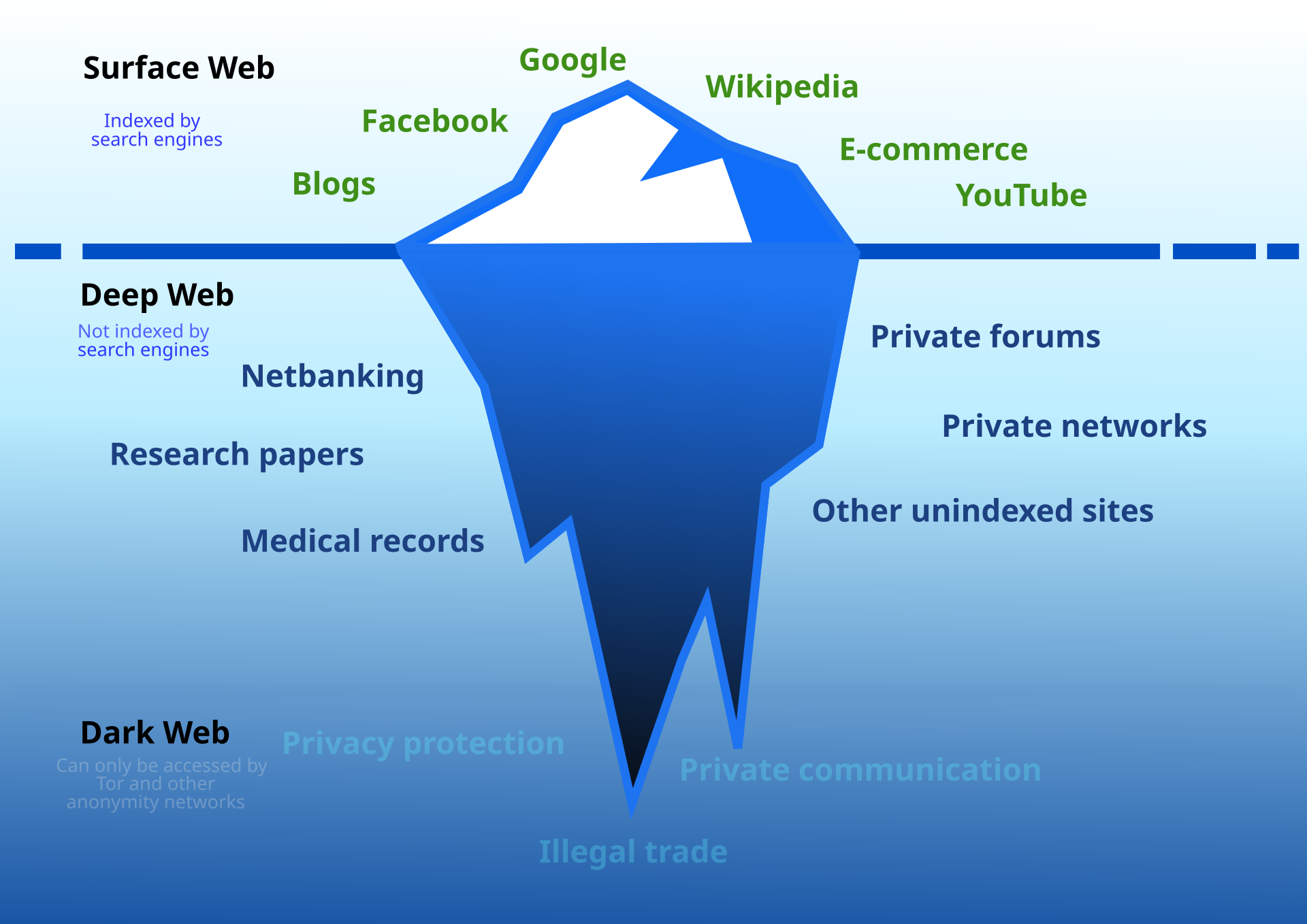
It is important to distinguish between the deep web and the darknet. The deep web encompasses everything a search engine cannot index — your email inbox, a university library database, a company's internal portal. The darknet is a subset of the deep web that is intentionally concealed and can only be reached through anonymous networks. Calling something "deep web" does not imply it is secret or illicit; most of the deep web consists of perfectly ordinary, legal content.
Layers of the Internet
Understanding the darknet requires a clear picture of how the internet is structured. The following table summarizes the three main layers:
| Layer | Access Method | Size (Approx.) | Examples |
|---|---|---|---|
| Surface Web | Standard browsers (Chrome, Firefox, Safari) | ~4–5% of the total web | Google, Wikipedia, news sites, social media |
| Deep Web | Login credentials, direct URLs, private networks | ~90–95% of the total web | Email (Gmail, Outlook), banking portals, academic databases, medical records |
| Darknet | Tor, I2P, Freenet, or other anonymity software | < 0.5% of the total web | .onion sites, hidden services, anonymous forums |
Surface Web
The surface web, also called the "visible web" or "clearnet," consists of all web pages that are indexed by standard search engines like Google, Bing, or DuckDuckGo. Anyone with a browser and an internet connection can access these pages without special permissions. Despite being the most familiar part of the internet, the surface web accounts for only a tiny fraction of the total information available online — estimates range from 4% to 5%.
Deep Web
The deep web includes every web page, database, or resource that is not indexed by search engines. This covers a vast range of content: private social media profiles, cloud storage files, behind-paywall journal articles, corporate intranets, government databases, and much more. The deep web is not inherently secret or suspicious — you interact with it every time you check your email or log into a bank account. Estimates suggest the deep web is 20 to 50 times larger than the surface web.
Darknet
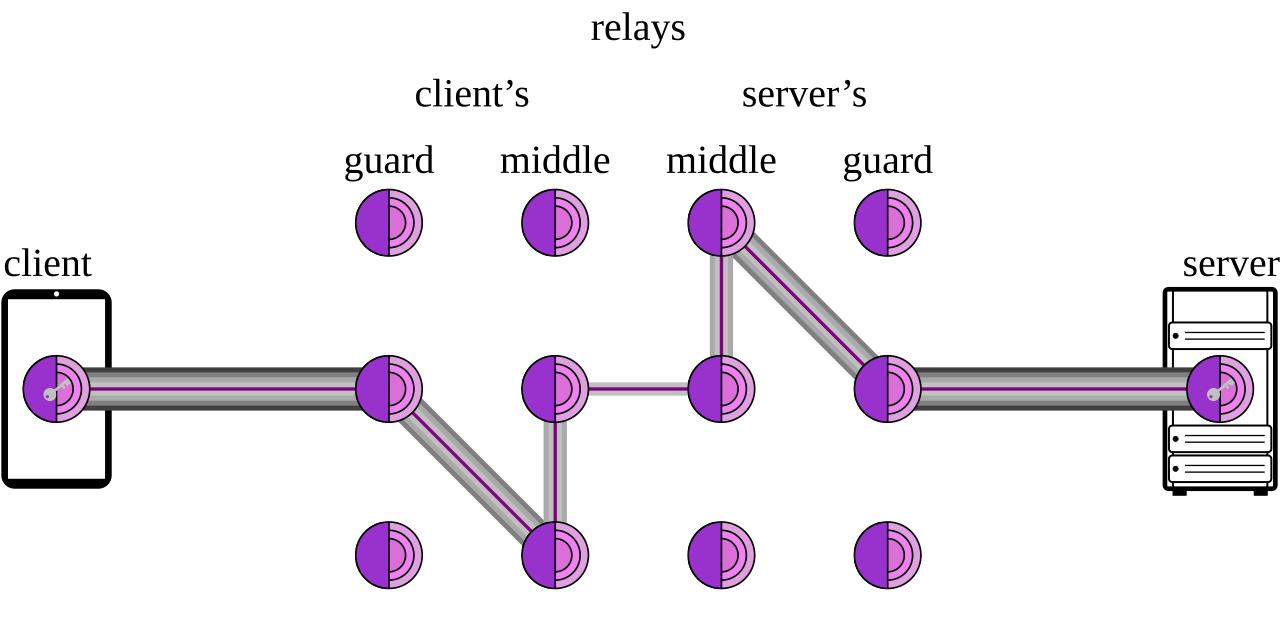
The darknet is a small, intentionally hidden portion of the deep web that requires specific software to access. The most common entry point is Tor Browser, which routes traffic through a series of encrypted relays to conceal the user's identity and location. Darknet websites use special domain names that are not resolvable through standard DNS — the most recognizable being the .onion top-level domain used by Tor hidden services.
Common Misconceptions
The darknet is the subject of widespread misunderstanding, much of it fueled by sensationalized media coverage. Below are some of the most persistent myths:
"The darknet is entirely illegal." While illegal activity certainly exists on the darknet — just as it exists on the surface web — a significant portion of darknet traffic is legitimate. Journalists, human rights activists, law enforcement agencies, researchers, and ordinary privacy-conscious individuals all use the darknet for lawful purposes. The technology itself, like Tor, was originally developed by the United States Naval Research Laboratory to protect government communications and remains a vital tool for dissidents operating under repressive regimes.
"Tor is only for criminals." This is perhaps the most common misconception. Tor (The Onion Router) is used by millions of people worldwide for a wide variety of reasons: journalists communicating with sources, whistleblowers leaking evidence of corruption, domestic violence survivors seeking help without their abuser finding out, soldiers accessing the internet from hostile territory, and everyday users who simply value their privacy and anonymity. Tor is a tool, and like any tool, its moral character depends on the user's intent.
"The darknet is the same as the deep web." As discussed above, the darknet is a small subset of the deep web. Using "deep web" and "darknet" interchangeably is inaccurate and contributes to public confusion. Your Gmail inbox is part of the deep web — but it is not part of the darknet.
"Everything on the darknet is anonymous." Perfect anonymity is difficult to achieve. While Tor and other networks greatly enhance privacy, they do not guarantee total invisibility. Law enforcement agencies have successfully de-anonymized darknet users through a combination of technical surveillance, operational security failures, and sophisticated traffic analysis. True anonymity requires careful OPSEC practices and a solid understanding of threat models.
The Technology Behind It
Several technologies enable the existence of the darknet. The three most prominent are Tor, I2P, and Freenet, each with its own architecture and use cases.
Tor (The Onion Router)
Tor is the most widely used darknet technology. It operates by encrypting a user's traffic and routing it through a series of three volunteer-operated relays, stripping away one layer of encryption at each hop — hence the "onion" analogy. This process makes it extremely difficult for anyone monitoring the network to determine the user's location or the destination of their traffic. Tor also supports "hidden services," websites that are hosted within the Tor network and accessible only through a .onion address. These services benefit from the same anonymity properties: neither the visitor nor the host needs to reveal their IP address. For a practical guide on getting started, see How to Use Tor Browser.
I2P (Invisible Internet Project)
I2P takes a different approach from Tor. Rather than routing traffic through a circuit of relays to reach the public internet, I2P creates a fully internal network where all communication stays within the I2P ecosystem. Every participant acts as both a client and a router, contributing bandwidth to the network while also using it. I2P is particularly well suited for services that both the host and the user want to keep within the anonymous network, such as forums, file sharing, and chat systems. Its internal addressing uses .i2p domains.
Freenet
Freenet is a peer-to-peer platform designed for censorship-resistant communication and file sharing. Unlike Tor and I2P, which focus on anonymous browsing and communication, Freenet emphasizes decentralized data storage. Files are encrypted, split into fragments, and distributed across the network, making it nearly impossible for any party to determine what is stored on a given node. Freenet is often used for publishing content that would be censored or suppressed under authoritarian governments.
Why People Use the Darknet
People access the darknet for a wide spectrum of reasons, ranging from activism and self-protection to curiosity and, in some cases, illegal commerce. A balanced understanding requires acknowledging all of these motivations.
Privacy and anonymity. In an era of mass surveillance, data brokerage, and increasingly intrusive advertising, many individuals turn to the darknet to reclaim their digital privacy. Journalists, lawyers, and researchers dealing with sensitive material often use Tor to protect their communications and sources. Privacy advocates argue that the ability to browse without being tracked is a fundamental civil right in the digital age. For a deeper discussion, see Privacy & Anonymity.
Circumventing censorship. In countries where internet access is heavily restricted or monitored — such as China, Iran, and Russia — the darknet provides a means of bypassing government firewalls and accessing blocked content. Tor bridges and pluggable transports allow users in these regions to connect to the network even when it is actively blocked.
Whistleblowing and journalism. Platforms like SecureDrop, which runs as a Tor hidden service, allow whistleblowers to communicate securely with news organizations. Notable leaks such as those published by WikiLeaks and Edward Snowden relied heavily on Tor-based anonymity to protect sources.
Darknet markets. It would be disingenuous to ignore the role of illegal commerce on the darknet. Since the rise of Silk Road in 2011, darknet markets have facilitated the sale of drugs, counterfeit documents, stolen data, and other illicit goods. These markets have attracted intense law enforcement scrutiny, leading to major takedowns such as those of AlphaBay, Hansa, and Hydra. While these markets represent a highly visible segment of darknet activity, they are far from the whole picture. The modern landscape of darknet markets — including platforms like DarkMatter and Nexus Market — is covered elsewhere on this encyclopedia.
Research and education. Cybersecurity researchers, academics, and law enforcement investigators study the darknet to understand emerging threats, track criminal networks, and develop defensive technologies. Many university programs include darknet analysis as part of their cybersecurity curricula.
The darknet is neither a utopian sanctuary nor a lawless wasteland. It is a complex, multifaceted space that reflects the full spectrum of human behavior — from the noblest impulses toward freedom and privacy to the darkest corners of criminal enterprise. Understanding it requires looking beyond the headlines and examining the technology, the history, and the people who inhabit it.