






Freenet — Censorship-Resistant Storage
Freenet is the oldest surviving darknet. Conceived in 1997 by Ian Clarke and released in 2000, it was built to answer a different question than Tor: not "how do I browse anonymously?" but "how do we publish something that can never be destroyed?" Its answer — a distributed data store spread across the machines of its own users — makes Freenet the darknet closest to the original cypherpunk dream of uncensorable information.
What Freenet is
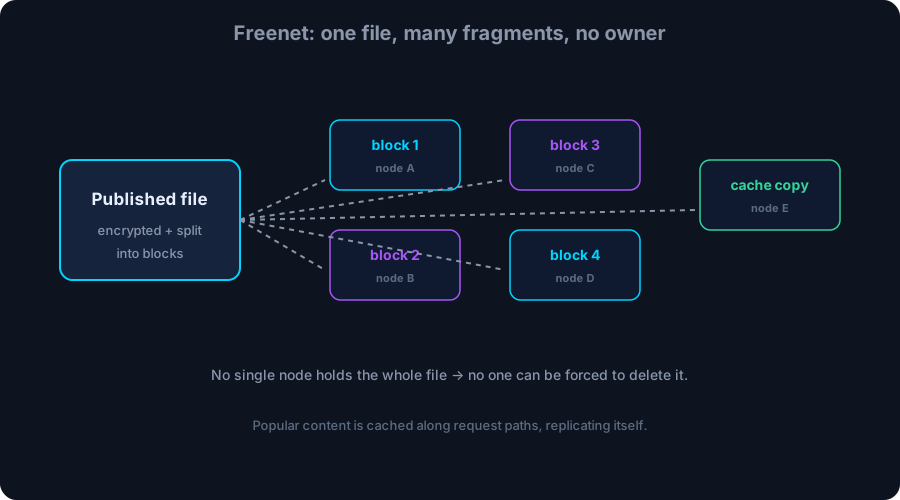
Freenet is a peer-to-peer network: there are no servers, no administrators and no central directories. Every participant installs the Freenet client, which allocates a slice of their disk and bandwidth to the network. Files are encrypted, fragmented and distributed across many machines, so no individual node holds a whole document — and no node's operator can be blamed for a specific file. This is the technical foundation of "plausible deniability."
How the distributed data store works
Think of Freenet as a global, anonymous hard drive where files are stored by content hash — an identifier derived from the file's contents rather than its location:
- When you publish, the file is split into encrypted blocks and spread across the network, each block placed on a node that is "near" the block's key in the network's addressing space.
- When you request a file, your client routes the query node-to-node toward the key. Each node checks its cache and forwards the query until the data is found.
- Requested data is cached along the path it traveled, so popular content replicates itself — the more people request a file, the more copies exist.
The practical consequence: a document can be removed only if every copy on every node is deleted — which, across a network with no central authority, effectively means it can never be removed.
Darknet mode vs. opennet mode
Freenet can run in two connectivity modes, and the distinction gave the term "darknet" one of its early technical meanings:
| Mode | Who you connect to | Trade-off |
|---|---|---|
| Darknet mode | Only peers you know personally (friends-of-friends) | Maximum anonymity and deniability; slower, requires building a social trust graph |
| Opennet mode | Any random Freenet node | Easy to join and faster; somewhat less resistant to sybil attacks |
In darknet mode, no outsider can even discover who is connected to whom — the network itself is hidden. This is the purest example of what "darknet" means: a network that is private to its members, not merely encrypted.
Freesites and communication
Freenet hosts freesites — static websites published inside the network — and the Frost communication system for forums and messaging. Because freesites are stored as data blocks rather than served from a machine, they stay online as long as anyone requests them. This made Freenet a favorite of communities that must outlast their host: authors, activists, whistleblowing archives and, inevitably, less savoury content. The network's neutrality is the point — and the controversy.
Strengths and trade-offs
- Survivability — content outlives any single operator, server or jurisdiction.
- Deniability — node operators cannot be shown to "possess" any file, because blocks are encrypted fragments.
- Resistance — there is no central authority to attack; censorship requires controlling the entire network.
The trade-offs are equally real: Freenet is slow (designed for latency-tolerant content, not real-time browsing), has a steep learning curve, and is not suited to commerce or interactive sites. For those reasons it plays a smaller role in the darknet's economy than Tor or I2P — but it remains the purest expression of the cypherpunk idea that information wants to be unkillable.
Freenet's place in the darknet
In the broader darknet architecture, the networks have complementary roles: Tor for anonymous communication with the open web, I2P for anonymous services within a network, and Freenet for anonymous, censorship-proof publishing. Together they demonstrate that "the darknet" is not one technology but a family of answers to the question the cypherpunks first asked in 1992: what happens to speech when no one can be forced to delete it?