







Darknet Myths vs. Facts
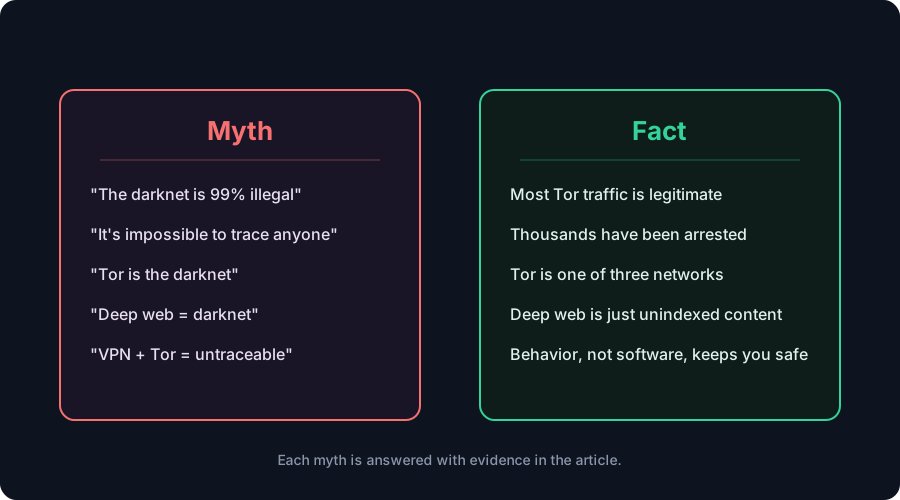
The darknet attracts more exaggeration than almost any other technology. Movies, news headlines and fearmongering have produced a set of claims that are repeated so often they are believed. Below are the most common myths, each paired with what the evidence actually shows.
Myth 1: "The darknet is 99% illegal"
Partly false. The network is not illegal — it is infrastructure. Most Tor traffic is legitimate: the Tor Project itself reports that the network carries journalistic, human-rights, corporate and private use at scale, and reputable organizations run official .onion sites. What is overwhelmingly illegal is a subset of the content: the commercial marketplaces and certain categories of abusive material.
It is fair to say that the darknet's most economically significant and visible activity is criminal. It is not fair to say that "the darknet" equals crime. The technology is neutral; what people build on it is not.
Myth 2: "It is impossible to trace anyone on the darknet"
False. Every major market has been taken down: Silk Road, AlphaBay, Hydra, Incognito. Operators and users are regularly arrested. Law enforcement does not break onion routing; it wins through infrastructure seizures, cryptocurrency forensics, undercover operations and — most often — the target's own mistakes in operational security. Anonymity is a property you maintain, not a guarantee you purchase.
Myth 3: "Tor is the darknet"
False. Tor is one anonymity network. The darknet ecosystem also includes I2P and Freenet, plus messaging apps and other channels. Even within Tor, the network itself is not "the darknet" — the hidden services people run on top of it are. The equation "Tor = darknet = crime" confuses infrastructure with content.
Myth 4: "The deep web and the darknet are the same thing"
False. The deep web is simply unindexed content: your email, your bank account, private databases. The darknet is a small subset of the deep web reachable only through anonymity software. Your webmail is deep web but not darknet. This conflation drives the "96% of the Internet is the darknet" statistic — which, even if the deep-web number were accurate, would say nothing about the darknet at all.
Myth 5: "Using a VPN with Tor makes you untraceable"
False. Layering a VPN over Tor adds a hop but does not solve the fundamental threats (traffic correlation, endpoint compromise, user error). It can even reduce anonymity if the VPN logs or if the configuration leaks. The Tor Project's guidance is that the Tor Browser is sufficient on its own. Security comes from behavior, not from stacking software.
Myth 6: "Everything on the darknet is anonymous, including payments"
False. Bitcoin — the original market currency — is pseudonymous, not anonymous. Its public ledger is the backbone of modern blockchain forensics, which is exactly why the ecosystem shifted to privacy coins like Monero. Even then, forensic techniques continue to advance. Anonymity is a spectrum, and it is shrinking at the edges.
Myth 7: "The darknet is just for buying drugs"
False. While drugs dominate darknet market revenue, the network itself hosts journalism, whistleblowing, free speech communities, research, privacy tools, and even official government presence (the CIA's .onion site, for example). Markets sell stolen data, fraud services and counterfeit goods alongside drugs. Reducing the darknet to drug shopping is like reducing the open web to its most disreputable corners.
Myth 8: "If I find a market, it's safe to use it"
False — dangerously so. Markets are routinely run by law enforcement after seizure (Hansa was operated by police for a month in 2017), and the most common fate of a large market is an exit scam that steals users' funds. Every market carries a real risk of financial loss and criminal exposure. There is no "safe" market; there are only markets that have not yet collapsed.
Myth 9: "The darknet is enormous — bigger than the surface web"
False. The deep web may dwarf the surface web in data volume (a claim that is itself contested and outdated), but the darknet is tiny: a few thousand reachable hidden services and, in the case of I2P, tens of thousands of users. The darknet is small, specialized and fragile — which is part of why markets keep consolidating and collapsing.
The bottom line
The darknet is a real technology with real consequences and real crime on it — but it is not a magical lawless realm. It is a set of protocols built by privacy researchers, used by both dissidents and criminals, and actively policed. Understanding it accurately is the first step to understanding both its value and its danger. See the history, the architecture and the safety guide for the evidence.