







Tor & Onion Routing
Tor — originally "The Onion Router" — is the most-used anonymity network in the world and the backbone of the modern darknet. It is free, open-source software run by a nonprofit, and it is used every day by millions of people. This article explains exactly how it works, who runs it, what the Tor Browser is, and where its anonymity genuinely ends.
What Tor is
Tor is two things at once. It is a software bundle (the Tor Browser) and a global network of volunteer relays that this software routes traffic through. The network is a worldwide volunteer infrastructure: any individual or organization can run a relay node, and the more diverse the relays, the stronger the anonymity.
At any moment, Tor routes traffic from millions of daily users through roughly 7,000–8,000 relay nodes. The network is operated by the Tor Project, a U.S. nonprofit founded in 2006, which develops the software, maintains the network's directory system and publishes research on anonymity.
A brief history of the project
Tor's origins are military. In the mid-1990s, mathematicians Paul Syverson, Michael Reed and David Goldschlag at the U.S. Naval Research Laboratory developed onion routing so that intelligence analysts could research the open web without exposing which government sites they were visiting. The code was released under a free license in 2004 with support from the Electronic Frontier Foundation, and the Tor Project became a nonprofit in 2006. (Read the full history.)
How onion routing works
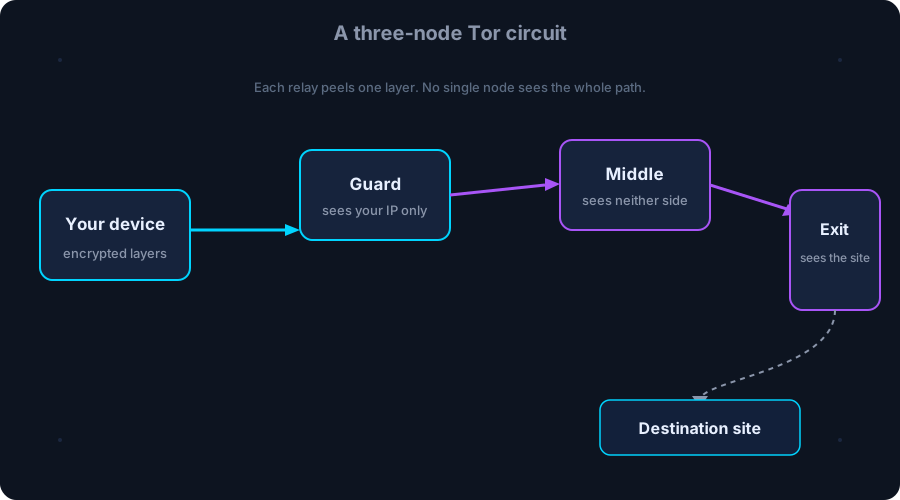
The name says it all: your data is wrapped in multiple layers of encryption, like an onion, and each relay removes one layer as the packet passes. Here is the journey of one web request:
Your device → Guard node → Middle node → Exit node → Website- Build a circuit. Your Tor client consults the network's directory to pick three relays at random: a guard, a middle and an exit. It negotiates a separate encryption key with each.
- Layer the encryption. The request is encrypted three times, once for each relay, so that only the relay the layer is addressed to can unwrap it.
- Forward one layer at a time. The guard unwraps the outer layer, sees only "send to middle," and forwards. The middle unwraps the next layer and forwards to the exit. The exit unwraps the last layer, reads the actual destination, and sends the plaintext request to the website.
- Return the response. The website replies to the exit, which encrypts the response back up the same chain in reverse order to you.
The crucial property: the guard knows who you are but not where you're going; the exit knows where you're going but not who you are; the middle knows nothing about either. Circuits are rebuilt every few minutes, and you keep the same guard for months to make you harder to de-anonymize by timing correlation.
The Tor Browser
The Tor Browser is a modified version of Firefox that comes pre-configured for anonymity: it routes all traffic through Tor, blocks browser fingerprinting techniques, disables risky plugins, and includes Bridges and Pluggable Transports for users in countries that block Tor itself. It is the entry point for most people into the darknet and the simplest way to visit .onion sites.
Legitimate uses
Most people associate Tor with markets, but the network's real users are overwhelmingly engaged in legal activity:
- Journalists and sources — secure, anonymous communication and document drops (e.g., The New York Times, BBC and ProPublica run .onion versions of their sites).
- Activists and dissidents — evading censorship and surveillance in restrictive countries.
- Law enforcement and security researchers — monitoring criminal activity and studying the network.
- Corporate analysts — collecting threat intelligence from the darknet.
- Private citizens — resisting ad tracking, data brokers and mass surveillance.
The Tor Project's position is that anonymity must be available to everyone or it is available to no one: a network that reliably excludes criminals would also exclude journalists and dissidents. This is why the Tor Project does not and cannot police what the network is used for.
Limitations and threats
Tor is not magic. Its known weaknesses define how real-world de-anonymization has actually happened:
| Threat | How it works |
|---|---|
| Traffic correlation | If the same party observes the entry and the exit of a circuit, they can statistically match flows by timing and size. This is the fundamental limit of any mix network. |
| Malicious relays | If an operator runs enough relays, the probability that they control both ends of a circuit rises. The Tor Project monitors relay distribution to counter this. |
| Exit-node sniffing | Traffic leaves the network in plaintext; an exit node can capture unencrypted HTTP. Using HTTPS inside Tor mitigates this. |
| User error | Logging into real accounts, pasting personal data, or enabling scripts defeats the point. Most arrests are caused by operator mistakes, not broken crypto. |
| Application bugs | Tor has been targeted by browser exploits and hostile .onion sites. Keeping the Tor Browser updated is mandatory. |
Importantly, Tor does not defend against endpoint compromise: if your computer is infected or your destination is hostile, no routing scheme can save you. It is one tool in a privacy stack, not a magic cloak. (See the safety guide.)