







I2P — The Invisible Internet Project
Tor is designed to give you anonymous access to the ordinary Internet. I2P — the Invisible Internet Project is built for the opposite goal: anonymous access to other I2P users. It is a self-contained network inside the Internet, optimized for hidden services it calls eepsites. This article explains garlic routing, tunnels, and why some security researchers consider I2P the technically stronger network.
What I2P is
I2P is a free, open-source anonymity network first released in 2003. Every participant is a peer: the software both sends and routes traffic for others, and everyone is identified by a cryptographic key rather than an IP address. Because all traffic stays inside the I2P network, there is no "exit node" that can observe plaintext traffic — a structural advantage over Tor when it comes to hidden services.
Garlic routing: onion routing's cousin
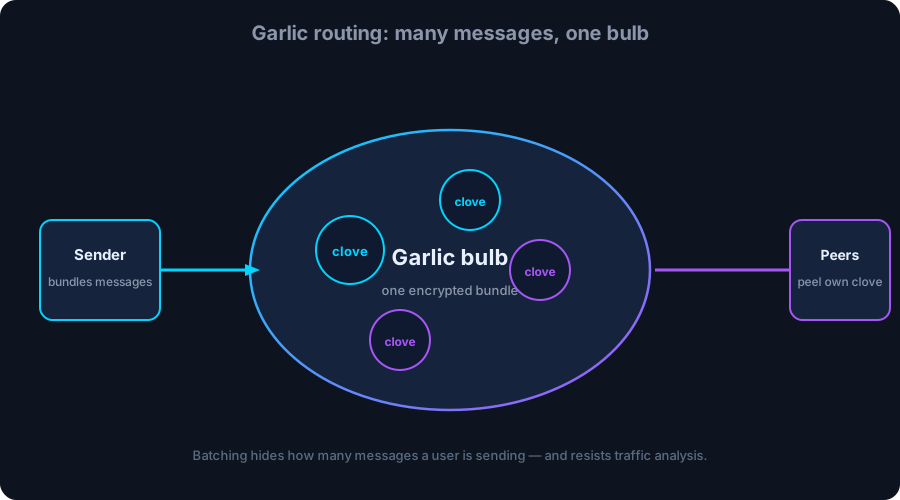
I2P uses garlic routing, invented by its founder jrandom. It improves on onion routing in one important way: instead of one message wrapped in layers, a sender can bundle multiple messages into a single "clove," wrap them together into one encrypted "garlic bulb," and let each recipient peel off only its own clove.
The practical advantages are significant:
- Batching — many small messages travel together, so an observer cannot easily tell how many messages a user is sending.
- Resistance to traffic analysis — the timing and size signatures that threaten Tor are much harder to read on garlic-routed traffic.
- Reliability — if one clove is delayed, the others are not affected.
Tunnels: inbound and outbound
Instead of Tor's three-node circuits, I2P uses unidirectional tunnels — think of them as one-way pipes through a handful of peers, with a distinct tunnel in each direction:
| Tunnel type | Direction | Purpose |
|---|---|---|
| Outbound tunnel | You → network | Carries messages you send, from your client to the rest of I2P. |
| Inbound tunnel | Network → you | Carries messages addressed to you, delivered through a fixed "gateway." |
Because outbound and inbound paths are separate and each is refreshed frequently, no single peer ever holds both halves of a conversation — and the "gateway" for your inbound tunnel acts like a mailbox that hides your true location. This is the mechanism that makes eepsites possible.
Eepsites and I2P services
An eepsite is I2P's equivalent of an .onion hidden service: a website hosted inside the network, reachable only by I2P users, at an address like:
http://forum.i2p / http://wiki.i2p / http://mysite.i2pBeyond websites, I2P hosts email (via Susimail / Postman), IRC servers, file-sharing and messaging. The network is comparatively small — a few tens of thousands of users — which makes it slower and harder to maintain than Tor, but also more private: small networks give an attacker less traffic to analyze.
I2P vs. Tor
| Feature | Tor | I2P |
|---|---|---|
| Primary use | Anonymous browsing of the open web + hidden services | Anonymous internal services (eepsites, email, chat) |
| Routing | Onion routing, 3-node circuits | Garlic routing, unidirectional tunnels |
| Exit nodes | Yes — exit traffic is visible to the exit | No exits — all traffic stays in-network |
| Network size | Millions of daily users | Tens of thousands |
| Accessing open web | Excellent | Possible via outproxies, but slow |
| Hosting hidden services | Good | Excellent (the network's native design) |
The standard mental model: Tor is the public road through a tunnel; I2P is the underground city. If your goal is to browse Facebook anonymously, use Tor. If your goal is to operate or visit services that exist only in the darknet, I2P is purpose-built for it — which is why many darknet forums and some markets operate I2P mirrors alongside Tor.
Who uses I2P
I2P's user base overlaps with Tor's, with some distinctions:
- Privacy enthusiasts who prefer a network with no exit nodes.
- Darknet market operators running I2P-only mirrors for resilience.
- Researchers studying onion/garlic routing differences.
- Dissidents in countries where Tor is aggressively blocked (I2P is harder to block because it resembles ordinary P2P traffic).
I2P does not make crime impossible — it makes it anonymous, exactly like every other tool. But its technical focus on serving the network's own inhabitants, rather than the open web, is what gives it a distinct place in darknet architecture. (Compare all networks.)