







Darknet Markets: How They Work
Darknet markets are anonymous online marketplaces that operate as hidden services. Since Silk Road in 2011, they have been the most studied — and most sensationalized — part of the darknet. Behind the headlines is a surprisingly ordinary economics problem: how do strangers who cannot trust each other do business without a legal system to enforce contracts? This article explains the institutional machinery they built to solve it.
What a darknet market is
A darknet market is, structurally, an e-commerce site: vendors list products with prices and photos, buyers place orders, and payments are settled in cryptocurrency. The differences are anonymity (both sides use Tor), censorship resistance (the site is a hidden service), and the absence of any licensed financial or legal intermediary. Markets charge vendors a commission — typically 2–8% of each sale — which funds operations and, in the best-run cases, escrow and support.
Escrow: solving the trust problem
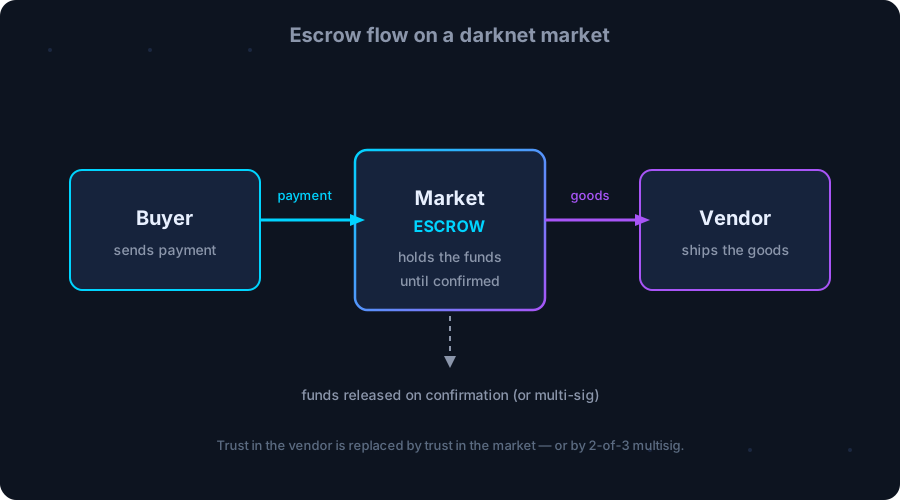
The defining problem of anonymous commerce is that a buyer cannot sue a seller who takes payment and never ships. The market's answer is escrow:
- The buyer sends cryptocurrency to an account controlled by the market, not the vendor.
- The vendor ships the physical goods (usually by postal mail, carefully packaged).
- On confirmation of receipt — or automatic release after a timer — the market pays the vendor.
- Disputes are resolved by market moderators, who decide who is entitled to the funds.
Escrow shifts trust from "the vendor" to "the market." That works brilliantly until the market itself is dishonest — which is exactly what happens in an exit scam.
Multi-signature protection
Because central escrow means the market can steal everyone's money at once, more sophisticated markets adopted multi-signature (multisig) payments. With multisig, the funds are locked on the Bitcoin blockchain and require signatures from two of three parties — buyer, vendor and market — to be spent:
- Buyer + vendor agree → payment released without the market touching it.
- Buyer + market agree → refund issued in a dispute.
- Vendor + market agree → vendor paid in a dispute.
Multisig removed the single point of failure: even if the market vanished, users could still finalize their trades without it. Adoption was slow because it demands technical skill, and most buyers still used central escrow out of convenience — a gap that exit scams continued to exploit.
Reputation systems
Every market runs a vendor rating system: buyers leave feedback, and vendors accumulate scores, review counts and sales volumes. These numbers are the market's real currency — a top-rated vendor commands premium prices, while a vendor with one bad week loses their entire customer base.
Reputation creates powerful incentives, but also its own failure modes:
- Fake reviews — vendors buy or trade positive ratings, sometimes via dedicated "review-upgrade" services.
- Wash trading — vendors buy from themselves through shell accounts to inflate volume.
- Selective scamming — a vendor builds a stellar reputation over months, then disappears with the largest batch of orders ("burner vendor" strategy).
The market lifecycle
Researchers who study markets observe a remarkably consistent pattern:
| Stage | What happens |
|---|---|
| Launch | A new market appears, often as a successor to a fallen one; DDoS attacks are common in the early days. |
| Growth | Vendors migrate in, volumes rise, and the market becomes the favorite of the community. |
| Maturity | Dominance is reached; fees and abuse grow; law enforcement takes notice. |
| Collapse | Either a takedown (seizure), an exit scam (the operators steal escrow), or both — often with the market running a "slow exit" by raising fees and refusing withdrawals first. |
The average lifespan of a large market has been measured in months, not years. The pattern is so reliable that "how to recognize a slow exit scam" is standard reading material for the security industry.
What is actually sold
Darknet markets are not the all-purpose criminal bazaars of popular imagination. Research by the Global Drug Survey and academic economists consistently finds:
- Drugs — the overwhelming majority of listings and revenue (cannabis, stimulants, psychedelics, pharmaceuticals).
- Digital goods — stolen data, databases, credentials, counterfeit documents.
- Financial services — money laundering, counterfeit currency.
- Weapons and other physical contraband — present but a small fraction of volume, because shipping them is far riskier.
Surprisingly to many, outright market share of violence-related goods is minimal. The dominant product category is recreational drugs — the same category that dominates the regulated e-commerce market for lifestyle goods.
Takedowns and resilience
Law enforcement's playbook has matured with the markets. The most effective operations combine several techniques:
- Infrastructure seizure — locating and confiscating the hidden service's server.
- Undercover vendor accounts — planting agents who build reputation and then steer users.
- Cryptocurrency tracing — following blockchain transactions from the market to real-world identities.
- Operator arrests — prosecuting the administrators, which destroys trust even if the code survives.
Yet the ecosystem is resilient: when one market falls, its vendors and customers migrate to the next, taking their reputation systems and escrow habits with them. This "revolving door" effect means the total volume of darknet commerce has remained stable or grown even through the largest takedowns in history. (Profiles of the major markets.)