







History of the Darknet
The darknet did not begin as a criminal network. It began as an idea — that ordinary people should be able to communicate and exchange information without exposing who they are. Its history is a chain of cryptographic experiments, a cypherpunk philosophy, a naval research program, one digital currency, and a series of online markets that changed how law enforcement thinks about the Internet.
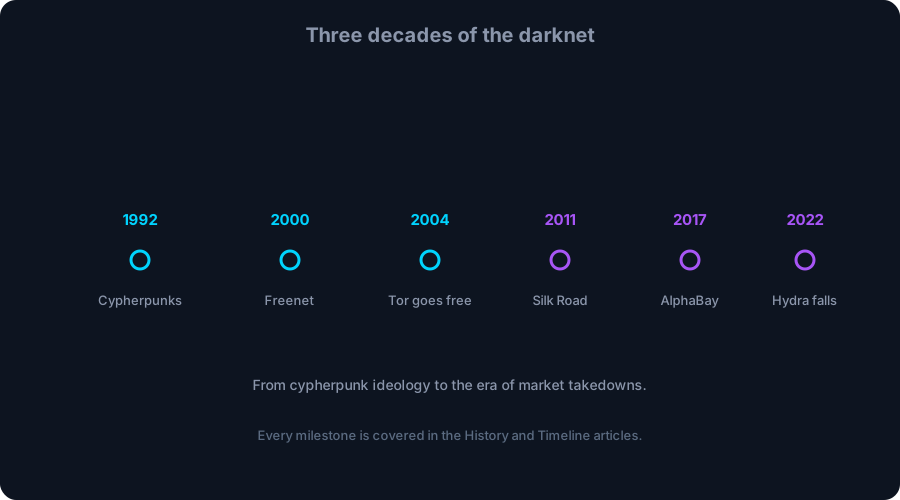
Origins: cryptography and the cypherpunks
The intellectual roots of the darknet lie in the cypherpunk movement of the late 1980s and early 1990s. In 1988, computer scientist Timothy C. May published the Crypto Anarchist Manifesto, arguing that cryptography would soon make it possible to conduct business, communicate and even govern in ways that governments could not trace. In 1992 he co-founded the Cypherpunks mailing list, which became the laboratory where anonymous-communication techniques were developed and debated.
In 1993, Eric Hughes — another founding figure — wrote A Cypherpunk's Manifesto, whose opening line became the movement's creed:
"Privacy is the power to selectively reveal oneself to the world."
The cypherpunks believed that privacy was not a secret kept from the state, but a technical property. That belief drove every technology that later became the darknet.
Anonymous remailers
The first practical anonymity tools were anonymous remailers — email servers that stripped identifying headers from messages and forwarded them under a pseudonym. The concept built on David Chaum's 1981 paper on untraceable communications, which introduced the "mix" — a server that shuffles and re-encrypts messages so an outsider cannot match sender to recipient.
- 1993 — The first cypherpunk remailer appears, offering simple pseudonymous forwarding.
- 1994 — Johan Helsingius launches the Penet remailer (anon.penet.fi), the first widely used anonymous email service, with over 600,000 users at its peak before legal pressure forced it to close.
- 1996 — Mixmaster remailers add layered encryption and batch mixing, the direct ancestor of Tor's design.
Remailers proved that anonymous communication was technically possible and politically explosive. But they relied on a single trusted server — a single point of failure that governments could and did shut down. The darknet needed a decentralized design.
Precursors: Eternity Service and Freenet
In 1996, Cambridge researcher Ross Anderson published a paper describing the Eternity Service — a distributed, tamper-resistant data store designed to survive censorship by replicating information across many machines. It was never fully built, but it defined the problem the darknet would solve.
In 1997, a young Scottish programmer named Ian Clarke published a proposal for Freenet: a peer-to-peer network where files are stored and retrieved anonymously across participants' machines, so no single server can be seized and no requester can be traced. Freenet was released in 2000 and remains the oldest still-running darknet technology. (Read more about Freenet.)
The word "darknet" itself was popularized later, in a 2002 Microsoft Research paper, The Darknet and the Future of Content Distribution, which used it to describe any private network used to share copyrighted files. The academic and popular meaning of the term has drifted since, but the concept — an encrypted layer of the Internet hidden from ordinary browsing — was already being built.
The invention of onion routing
The technology that defines the modern darknet — onion routing — was invented in the mid-1990s at the United States Naval Research Laboratory (NRL) by mathematicians Paul Syverson, Michael Reed and David Goldschlag. The Navy needed a way for intelligence officers to browse the open Internet without revealing which sites they were visiting or from which government network.
Their solution: encrypt a message in layers ("like an onion"), then send it through a chain of independent relay computers, each peeling off one layer of encryption. No single relay knows both the origin and the destination, so no single point of compromise reveals the full path.
In 1997 the team built a working prototype called Tor — "The Onion Router." By 2002 the code was deployed and the source was released under a free license so that anyone could run a relay.
Tor goes public
In 2004, the Electronic Frontier Foundation began funding Tor development. In 2006, the nonprofit Tor Project was founded to maintain the network, and it grew quickly as a tool for journalists, activists, dissidents and ordinary users in countries with aggressive censorship or surveillance.
- 2004 — Tor's source code released under a free (BSD) license.
- 2006 — The Tor Project is incorporated as a nonprofit.
- 2008 — The Tor Browser package is introduced, making the network usable by non-experts.
- 2013 — .onion addresses gain official status as a special-use domain name.
Notably, Tor was never "the darknet" by itself. It is a network of relays. The darknet content — hidden services, markets, forums — is what people built on top of Tor, using the same onion-routing principles. The Tor Project's own mission remains human-rights focused: defending anonymity for everyone, including criminals, because a network that can be selectively broken is a network that is broken for everyone.
Bitcoin: the missing payment layer
Anonymity software alone was not enough to build a market economy. Buyers and sellers still needed a way to pay each other without exposing their identities through banks. That missing layer arrived on 31 October 2008, when the pseudonymous Satoshi Nakamoto published the Bitcoin whitepaper, followed in January 2009 by the first block of the Bitcoin network.
Bitcoin was never designed for the darknet. But its properties — pseudonymous addresses, no central authority, irreversible payments — made it the only viable currency for anonymous commerce. Within a few years, "BTC" became the universal medium of exchange on hidden services, and Bitcoin's blockchain history became the evidence that law enforcement would later use to trace users. (Read more about cryptocurrency on the darknet.)
Silk Road and the market era
In February 2011, a Texas-born engineer using the alias Ross Ulbricht — "Dread Pirate Roberts" — launched Silk Road, a hidden service on Tor where vendors sold goods, primarily drugs, using Bitcoin and an escrow system. It was not the first anonymous market, but it was the first that worked at scale: by 2013 it had more than one million customer accounts and moved an estimated $1.2 billion in sales.
Silk Road's innovation was institutional. It introduced escrow, a vendor rating system, a dispute-resolution process and an automated fee structure — the same trust machinery that legal e-commerce platforms use, rebuilt for anonymity. Those design choices became the template for every darknet market that followed. (Read more about how markets work.)
The great takedowns
The history of the darknet's market era is also the history of its takedowns. Each generation of markets grew, and each generation was eventually dismantled — usually through a combination of server seizures, payment tracing and operator mistakes.
| Event | Year | Significance |
|---|---|---|
| Silk Road shut down; Ulbricht arrested | 2013 | First major market destroyed; founder sentenced to life in prison in 2015 |
| Operation Onymous | 2014 | Europol-led takedown of Silk Road 2.0, 400+ .onion sites |
| Evolution exit scam | 2015 | Market disappears with millions of user funds — a defining exit scam |
| AlphaBay and Hansa taken down | 2017 | Largest takedown to date; AlphaBay had ~200,000 users and $1B+ in sales |
| Wall Street Market seized | 2019 | German-led operation against one of the largest markets |
| Hydra taken down | 2022 | Largest market in the world (~$5B+ in volume), seized by German authorities |
Each shutdown created a vacuum filled by the next market. This "whack-a-mole" dynamic — documented extensively by researchers at Carnegie Mellon, RAND and Chainalysis — is the central fact of darknet market history.
The darknet today
Since the fall of Hydra, the market ecosystem has fragmented. Key trends include:
- Monero replaces Bitcoin as the preferred payment method, because its ring signatures defeat blockchain analysis that traced Bitcoin payments.
- Smaller, more resilient markets replace single dominant platforms, often using multi-sig escrow to protect user funds.
- DDoS extortion and exit scams remain the leading causes of market collapse.
- A shift toward encrypted messaging apps (Telegram channels, session-based services) for smaller-scale commerce.
- Growing corporate and academic interest: cybersecurity firms, journalists and researchers now monitor the darknet as a standard intelligence source.
The darknet's future is not a question of whether it will exist — onion routing and decentralized storage are established technologies. The open questions are how anonymity and regulation coexist, and whether the markets that made the darknet infamous will continue to drive its evolution.