







Darknet Timeline
The darknet is barely three decades old, but its history reaches back to the earliest research on the Internet. Below is a chronological overview of the ideas, technologies, networks and markets that built it.
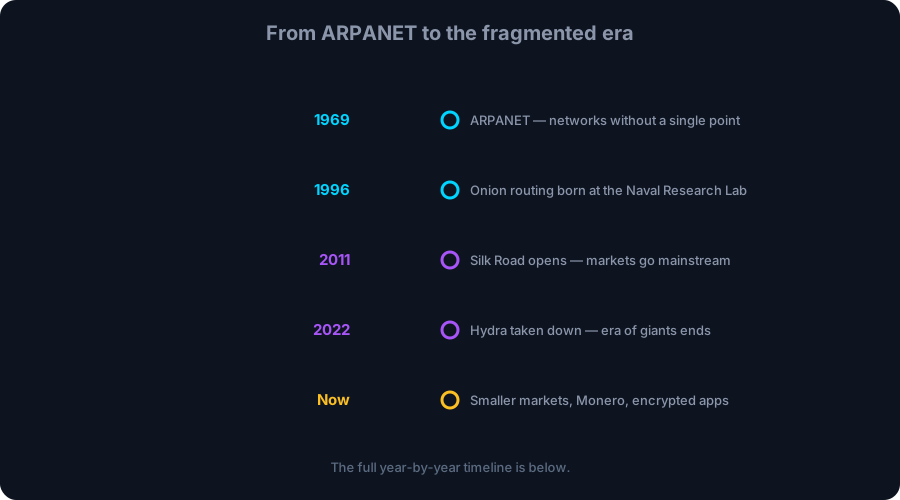
ARPANET connects four universities
The predecessor of the Internet is created as a U.S. military research network. Designed to survive node failure, it plants the idea that networks can be built without a single point of control — a principle the darknet later adopts.
Chaum publishes "Untraceable Communications"
Computer scientist David Chaum introduces the mix — a server that shuffles and re-encrypts messages. It is the mathematical foundation of all anonymous routing that follows.
The Crypto Anarchist Manifesto
Timothy C. May publishes his manifesto arguing that cryptography will enable untraceable transactions and communications, undermining state control of information.
The Cypherpunks mailing list is founded
May and Eric Hughes launch the Cypherpunks list. For a decade it is the workshop where anonymous remailers, digital cash and privacy tools are designed and tested.
First anonymous remailers
The first cypherpunk remailers appear, stripping sender identities from email. Hughes publishes A Cypherpunk's Manifesto the same year.
Penet remailer (anon.penet.fi) peaks
Johan Helsingius runs the first mass-market anonymous email service, with hundreds of thousands of users, until legal pressure from the Church of Scientology forces its closure in 1996.
Eternity Service proposed; onion routing born
Ross Anderson proposes the Eternity Service (censorship-resistant storage). Separately, at the U.S. Naval Research Laboratory, Syverson, Reed and Goldschlag begin building onion routing.
Freenet proposal; Tor prototype
Ian Clarke proposes Freenet, a peer-to-peer censorship-resistant network. The NRL team builds the first Tor — "The Onion Router" — prototype.
Freenet released
Freenet goes live as the first widely available decentralized darknet, still running today.
Tor deployed; the term "darknet" is coined
Tor's second-generation design is deployed and its source is released. A Microsoft Research paper — The Darknet and the Future of Content Distribution — popularizes the word "darknet."
Tor released under a free license
With funding from the Electronic Frontier Foundation, Tor's source becomes freely available, allowing anyone to run relays and build on the network.
The Tor Project is founded
The nonprofit is incorporated to maintain Tor, funded largely by the U.S. State Department and the EFF, with the mission of defending anonymity for all users.
Bitcoin whitepaper published
Satoshi Nakamoto publishes Bitcoin: A Peer-to-Peer Electronic Cash System — the payment layer the future darknet markets will depend on.
Bitcoin network launches
The first block is mined in January. Bitcoin's pseudonymity and irreversibility make it the natural currency of anonymous commerce.
Silk Road opens
Ross Ulbricht ("Dread Pirate Roberts") launches Silk Road on Tor. It popularizes escrow and reputation systems, and grows to over a million accounts and an estimated $1.2 billion in sales.
Silk Road shut down
The FBI seizes Silk Road and arrests Ulbricht. He is later sentenced to life imprisonment. Tor exits become a mainstream topic in the media.
Operation Onymous
Europol-led operation takes down Silk Road 2.0 and hundreds of .onion sites, demonstrating the scale of international darknet policing.
Evolution exit scam
The Evolution market vanishes with an estimated $12 million of user funds — one of the most notorious exit scams and a warning about trusting central escrow.
AlphaBay and Hansa taken down
In one coordinated operation, AlphaBay (then the largest market, ~200,000 users) is seized by U.S. and Thai authorities, and Hansa by Dutch police. The largest darknet takedown of its time.
Wall Street Market seized
A German-led operation takes down Wall Street Market, one of the last large markets of the era, following an internal exit scam.
Hydra taken down
German police seize the servers of Hydra — the world's largest darknet market, with an estimated $5 billion+ in transactions and 23 million users — in April 2022. It never returns.
The fragmented era
No single dominant market emerges after Hydra. Markets become smaller, use Monero, rely on multi-sig escrow, and increasingly move toward encrypted messaging apps. DDoS extortion and exit scams remain constant threats.